Introduction
Open with a relatable moment: someone buying a diffuser for the first time, staring at a shelf of bottles, unsure whether “essential oil” and “fragrance oil” are interchangeable marketing terms or something that actually matters. Acknowledge that most people assume “oil is oil” until their diffuser smells weak, fades fast, or irritates a pet — and that’s usually a sign they picked the wrong type for their goal.
Set the promise clearly: by the end of this, the reader will know which type suits their diffuser, their room, and their reason for scenting the space — whether that’s ambiance, therapy, or covering odors. Keep tone conversational and confident, not overly technical yet — save the depth for section 2.
The Core Difference, Explained Simply
Lead with the plant-source distinction: essential oils come directly from a single botanical source through steam distillation, cold pressing, or resin tapping — lavender oil comes only from lavender, rose oil only from roses. Nothing is added; what you’re smelling is (mostly) the plant itself, concentrated.
Fragrance oils work differently — they’re formulated blends built to hit a target scent, whether or not that scent exists as an extractable plant. Explain why this matters: a “rain” or “clean linen” fragrance oil couldn’t exist as an essential oil because there’s no plant to distill it from. Fragrance oils combine aromatic compounds — some naturally derived, some synthetic — specifically to achieve complexity, layered notes (top, heart, base), and batch-to-batch consistency that pure plant extracts can’t guarantee.
Be direct about where Coral Aroma’s own catalog sits: lines like “Address Inspired,” “Dubai Mall Inspired,” and “Four Seasons Inspired” are fragrance oils — built to recreate a specific ambient signature scent, not extracted from one plant. This isn’t a downside to hide; it’s the reason those scents can replicate something as specific as a hotel lobby smell in the first place. Naming this openly builds credibility rather than letting the reader assume otherwise.
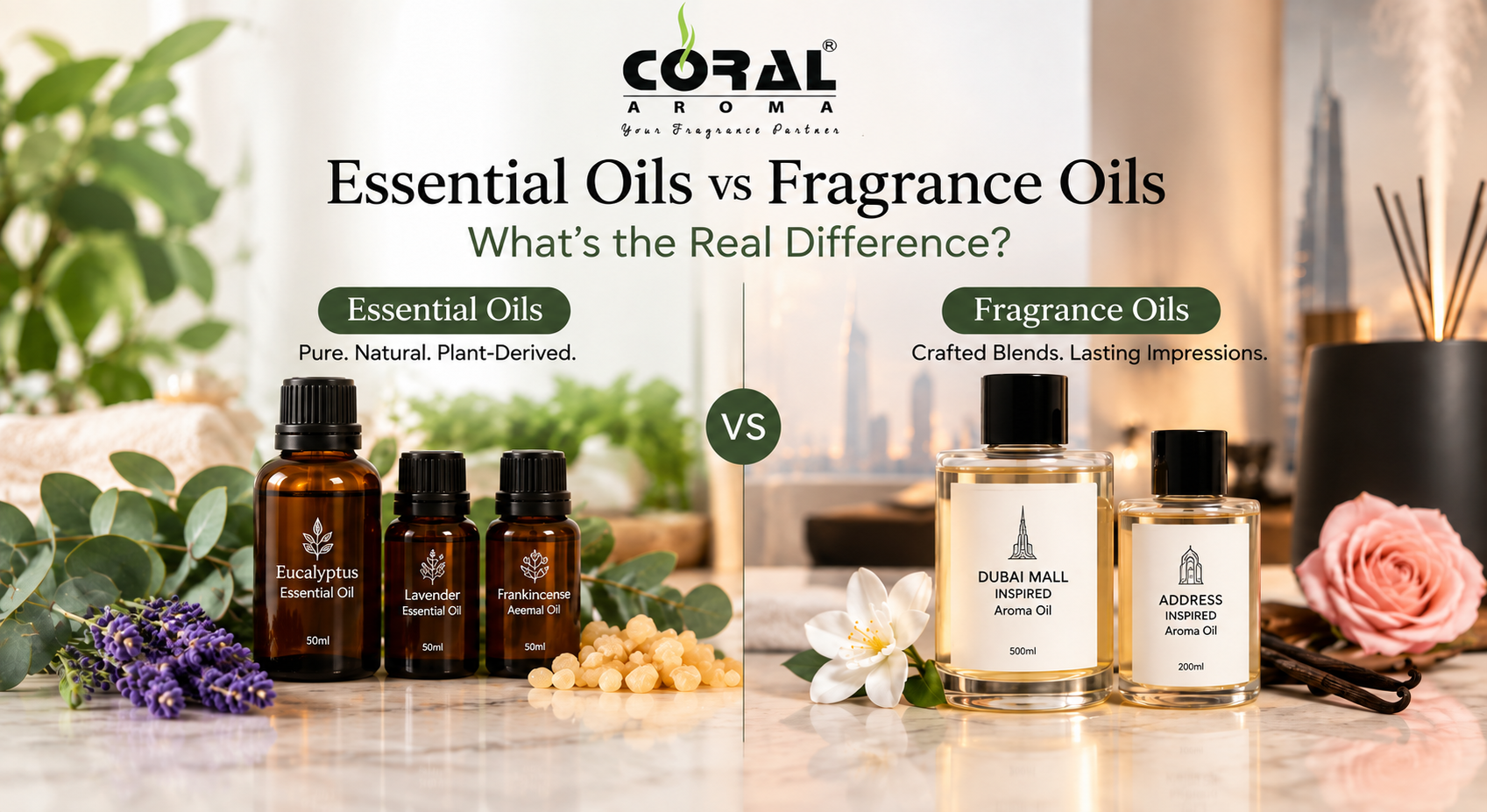
Real examples from the Coral Aroma catalog, to make the distinction concrete for readers:
Essential oils (pure, single-source extracts):
- Eucalyptus Essential Oil (50ml) — undiluted, no carrier oils or fillers; used for congestion relief, focus, and easing sore muscles.
- Macadamia Essential Oil (50ml) — a buttery, moisturizing oil rich in oleic and palmitoleic acids, popular for skin, hair, and massage use.
- Frankincense Essential Oil (part of the 5 x 50ml Essential Oil Bundle, alongside Lemongrass, Lemon, and Eucalyptus) — deep and resinous, used for relaxation and reflection.
Fragrance oils (formulated blends for diffuser performance):
- Address Inspired Aroma Oil — part of the hotel-inspired range, built to recreate a specific luxury-hospitality signature scent.
- Dubai Mall Inspired Aroma Oil — a landmark-inspired blend designed for strong throw and consistency across a large retail-style space.
- Oriental Blossom Aroma Oil — a floral oriental blend combining jasmine, rose, amber, and musk notes, available in 200ml–500ml sizes.
These pairings are useful to reference directly in the article, since they let the reader see the difference in real product listings rather than as an abstract concept — link each example to its live product page.
Performance: Throw, Longevity, Consistency
Explain “throw” simply — how far and how strongly a scent travels through a room — and why fragrance oils are generally engineered to perform better here. Because they’re formulated rather than extracted, manufacturers can adjust concentration and note balance specifically for diffuser performance, producing a stronger, more even scent across several hours.
Essential oils, being a natural product, vary more from batch to batch depending on harvest, climate, and extraction conditions — the same lavender oil bottle bought twice a year apart might smell subtly different. They also tend to be lighter and more delicate in a diffuser, sometimes requiring a higher dose or a diffuser specifically suited to essential oils to fill the same size room a fragrance oil would cover easily.
Make the commercial-scale point concrete: this is exactly why hotels, malls, and airlines almost universally choose fragrance oils for signature scenting — when a five-star lobby needs to smell identical every single day across multiple locations, repeatability beats natural variation. Tie this back to Coral Aroma’s own B2B clients (Emaar, Four Seasons) as a real-world proof point, without turning it into a sales pitch mid-section.
Which One for Which Use Case
Rather than a strict rule, think of this as a quick-reference guide — some overlap is fine depending on personal preference.
For a strong “designer perfume” ambient smell in a living room, go with a fragrance oil. It’s formulated specifically for diffuser performance, so it fills a room with a strong, layered scent and holds that strength consistently for hours rather than fading after the first thirty minutes.
For therapeutic use — sleep, stress relief, or focus — go with an essential oil. Its value here comes from being a pure, single-source plant extract, which is what most aromatherapy practices and studies are actually built around; the plant-based purity is the point, not just the smell.
For scenting a small enclosed space like a car, go with a fragrance oil. In a confined space, its stronger scent throw per drop means a noticeable, lasting effect without needing to reapply constantly, which matters when reapplication isn’t always convenient on the road.
For diffusing around infants or pets, go with an essential oil, but only heavily diluted and after checking with a vet or pediatrician first. It generally contains fewer synthetic compounds, though “natural” doesn’t mean automatically risk-free, so caution and moderation still matter.
For a signature scent in a business or hotel lobby, go with a fragrance oil. Businesses need the exact same smell every day across every location, and a formulated fragrance oil delivers that batch-to-batch consistency in a way a naturally variable plant extract can’t guarantee.
Beyond these specific cases, many people simply prefer one over the other for reasons that have nothing to do with performance — some find pure essential oil scents more “honest,” others prefer the richer, more complex profile a fragrance oil can achieve. Both are valid starting points.
Can You Mix Them?
Answer directly: yes, in many diffusers you can blend a fragrance oil with an essential oil to create a custom scent profile — this is common practice among home diffuser users experimenting with their own signature blend.
Add the necessary caveat: check the diffuser’s manufacturer guidance first, since some ultrasonic diffusers are designed only for water-based use or specific essential oil concentrations, and introducing an oil-based fragrance blend not rated for that device can damage it or void a warranty. Cold-air and nebulizing diffusers are generally more flexible with oil-based fragrance blends than ultrasonic ones. When in doubt, test a small mixed batch before committing a full bottle.
Where Coral Aroma Fits
Present both ranges as two solutions for two different intentions rather than upselling one over the other. The fragrance oil catalog (300+ blends spanning hotel-inspired, perfume-inspired, and Arabic aroma collections) suits anyone chasing a specific, memorable signature scent for a home, car, or business. The essential oil line suits anyone prioritizing plant-based purity for aromatherapy-focused use.
Link directly to both category pages here, framed as “explore the range” rather than a hard sell — the goal of this section is to make the reader’s next click obvious, not to argue they need to buy anything specific.
FAQ Block
Is fragrance oil bad for you?
Not inherently — a well-made fragrance oil, especially one that’s IFRA-compliant, is manufactured to safety-tested concentration limits. Irritation issues usually come from poor-quality, unregulated oils rather than fragrance oils as a category. As with any diffused scent, ventilate the room and avoid extremely high concentrations, particularly around anyone with respiratory sensitivities.
Can I use essential oil in any diffuser?
Not always. Ultrasonic diffusers are generally fine with essential oils since they’re designed for water-oil mixtures, but nebulizing diffusers (which disperse pure, undiluted oil) work best with essential oils specifically formulated for that method. Always check your diffuser’s manual — using the wrong oil type in the wrong device can clog it or shorten its lifespan.
Which lasts longer, essential oil or fragrance oil?
Fragrance oils generally last longer in terms of scent throw over time, since they’re engineered for diffuser performance and consistency. Essential oils can be more delicate and may need topping up more frequently to maintain the same strength, though this varies by oil and by diffuser type.
Can fragrance oils and essential oils be blended together?
Yes, many people do this to create a custom scent — just confirm your specific diffuser supports oil-based blends before mixing, since some ultrasonic models are only rated for water-based use with essential oils in small concentrations.