
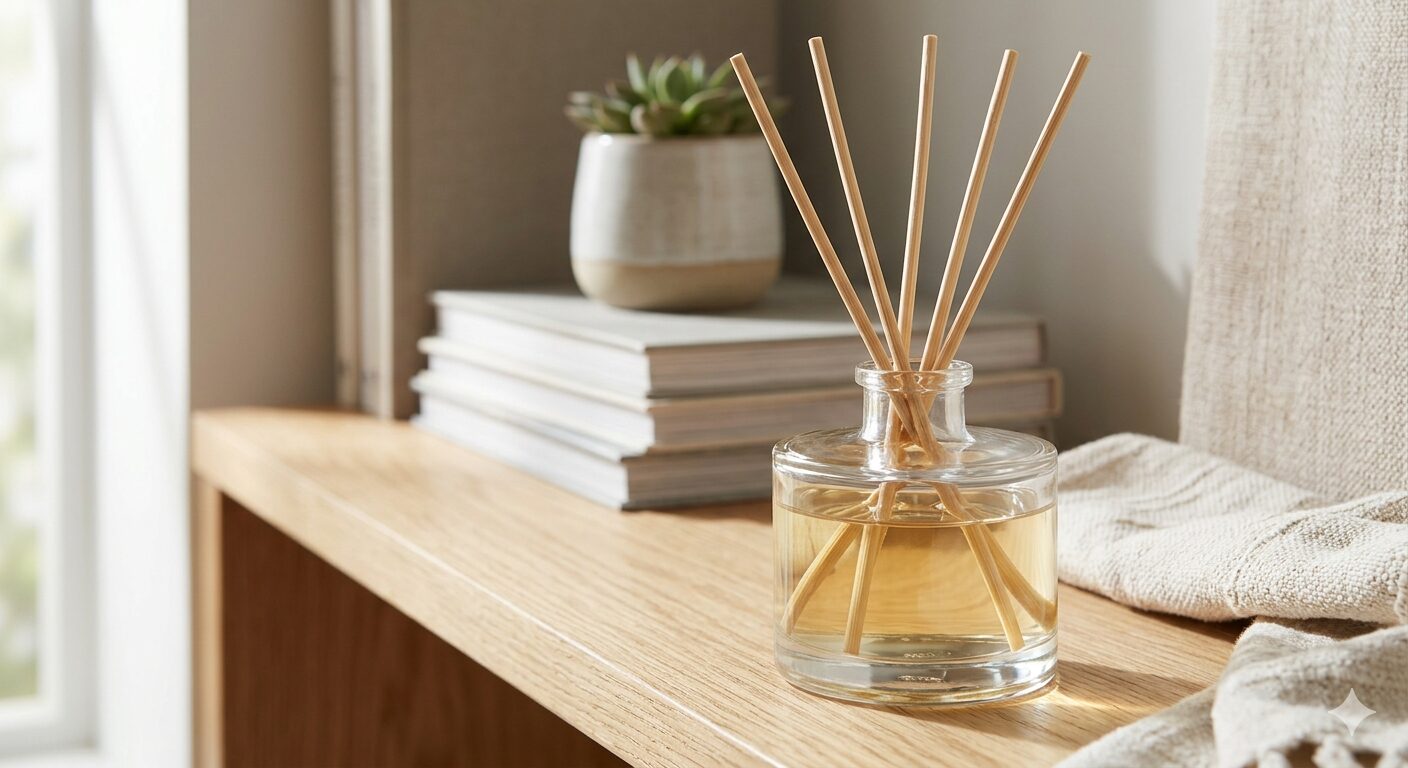
You’ve probably walked past one a hundred times without really registering it. A little glass bottle. Some sticks. No plug, no button, no obvious reason it should do anything at all.
And then the room smells genuinely good, and you have no idea why.
Reed diffusers are weirdly underestimated. Most people buy one, put it somewhere, and sort of forget about it — which, honestly, is kind of the point. But if you’ve ever wondered what’s actually happening inside that bottle, or why yours stopped working, or whether it’s worth spending more on a better one, the answers are all in the mechanics. And the mechanics are interesting.
Three Parts. All of Them Matter.
A reed diffuser is three things: a vessel, an oil, and some reeds. Simple enough. What most people don’t realize is that if any one of those three is wrong, the whole thing fails—even if the other two are excellent.
The vessel is the bottle or container holding the oil. Glass is most common. Ceramic and stone show up in pricier products. Here’s the part people overlook: the width of the opening changes how the diffuser behaves. A wide mouth means more oil evaporates straight off the surface—a stronger scent, but the bottle empties faster. A narrow neck keeps most of the fragrance work happening through the reeds themselves, which slows things down and gives you more control. If you want to adjust intensity, you add or remove reeds. The vessel shape sets the baseline.
The oil is more complicated than it looks. It’s not pure essential oil—and that distinction actually matters. Essential oils are thick, chemically dense, and not particularly good at moving up through reed channels on their own. Diffuser oil is specifically made for this. It blends fragrance concentrate with a lightweight carrier — usually something like dipropylene glycol or isopropyl myristate — that thins the mixture just enough for the reeds to pull it upward cleanly.
The carrier base is one of those things that cheap products get wrong. A poor formulation distorts the scent on the way up, clogs the reeds within a few weeks, or separates over time. A good one keeps the fragrance intact from the bottom of the bottle to the open air at the tip of the reed. You won’t see this on most labels, but it’s worth asking about if you’re buying from a smaller brand.
The reeds are almost always rattan. Not bamboo — rattan. Bamboo is hollow but has nodes (those little rings along the stalk) that interrupt the channel. Rattan has continuous, unbroken channels running from one end to the other. That’s the whole game. Those channels are what pull oil upward, and they need to be clear and open the entire length of the reed, or nothing moves properly.
The Physics of a Stick in a Bottle
The mechanism is called capillary action. It’s the same force that moves water from roots up through plant stems — the same thing that makes a paper towel soak up a spill from the bottom up. No pump, no electricity, no external pressure. Just the way certain liquids behave when they’re in contact with the right material.
When rattan reeds sit in diffuser oil, the oil is attracted to the inner walls of those channels. Surface tension does the rest — pulling the liquid upward through the reed over the course of several hours. Eventually it reaches the top, where it meets open air.
At that point it evaporates. As it evaporates, it releases the fragrance compounds that were dissolved in it. Those compounds spread through the surrounding air — that’s what you’re smelling.
What makes it work continuously is that as oil evaporates from the top of the reed, more is drawn up from below to replace it. The process is self-sustaining as long as two things are true: there’s oil in the vessel, and the channels in the reeds are still open.
They don’t stay open forever. Over time, the channels accumulate dust, oxidized oil residue, and other material that slows and eventually stops the capillary flow. Flipping the reeds—turning them upside down—gives you a burst of stronger scent because you’re exposing cleaner, less clogged channels to the oil. Do that a few times, and eventually even the “clean” end has been used. At that point, new reeds are the only fix. Flipping won’t help anymore.

Reed Diffuser vs. Electric Diffuser
Honestly, this is less of a competition and more of a compatibility question.
A reed diffuser is always running. You set it up, and it does its job—no timer, no refill of water, no noise, no heat. The scent is soft and consistent. It’s the kind of fragrance you notice when you first walk into a room, then stop consciously registering because it becomes part of the space. For bathrooms, hallways, and a home office you step away from and come back to—this is what you want. Something that holds the room without needing attention.
An ultrasonic or electric diffuser is different in kind, not just in intensity. It gives you deliberate control. You turn it on when you want it, adjust the strength, and switch oils easily. The effect is more immediate and more dramatic. For a bedroom you want to smell a certain way before sleep, or a living room you’re scenting ahead of guests—that active, on-demand quality is genuinely useful.
The trade-off is straightforward: electric diffusers reward engagement. Reed diffusers reward forgetting about them.
A lot of people end up with both—a reed diffuser in the entrance or bathroom and an electric diffuser in the main living space—and that combination makes sense. Different tools for different jobs.
How Long Will It Actually Last?
A 100ml diffuser typically runs six to eight weeks. A 200 ml one, three to four months. Both of those are averages that shift pretty meaningfully depending on what you do with it.
The number of reeds is the most controllable variable. More reeds mean more surface area evaporating at once, which means a stronger scent but faster oil consumption. If longevity matters more than intensity right now, pull out a few reeds. Add them back later if the scent feels too faint.
Placement matters more than people think. A diffuser near an air conditioning vent or a fan will evaporate faster—the moving air carries fragrance away more efficiently, which is actually good for scent throw, but it shortens lifespan. Near a sunny window or on top of a warm surface, it has the same effect. Somewhere with still air, the oil lasts longer, but the scent stays closer.
If You’re Buying in the UAE — A Few Honest Notes
The climate here creates some conditions that don’t come up in most product descriptions written for European or North American markets.
Heat speeds everything up. An air-conditioned home is fine, but any diffuser catching direct afternoon sun through a window is burning through oil faster than the bottle suggests. Keep them away from south-facing glass and away from kitchen heat. It’s a small thing but it adds up.
Air conditioning is actually an advantage. The dry indoor air that A/C produces is genuinely ideal for reed diffuser performance. Humid air slows evaporation; dry air accelerates it. You’ll often find that a diffuser performs noticeably better here than in a wetter climate. The scent throw can be stronger than you’d expect.
The oil formulation matters more in heat. Cheaper bases can separate, discolor, or start to smell off when exposed to warmth over weeks. Dipropylene glycol is the most stable carrier across temperature ranges—worth checking if a brand is transparent about their base. If they’re not, that’s information too.
Buy a bit more volume than you think you need. A diffuser that lasts two months in a cooler climate might go six weeks in a well-air-conditioned UAE home. Plan for that when you’re deciding between sizes.
Keep spare reeds on hand. The right size of rattan reed isn’t always easy to find locally between refills. Buying a spare set when you buy the oil means you’re never stuck waiting on a delivery before you can get the diffuser working properly again.
The Quiet Version of Luxury
There’s no setup difficulty here. No manual, no learning curve, no subscription. Just oil, reeds, and a bottle.
Get those three things right—a good oil, a quality carrier base, proper rattan reeds, and a placement that suits the room—and it asks almost nothing from you after that.
The way a space smells is more tied to how it feels than most people consciously register. A reed diffuser, sitting somewhere in the corner of a room you barely look at, works on that feeling every hour. Quietly. Without asking you to notice.
That’s a strange amount of return for something so small.