What Is a Reed Diffuser?
A reed diffuser is a passive home fragrance device that disperses scent continuously into a room without heat, flame, or electricity. It consists of three components: a glass or ceramic vessel filled with fragrance oil, a set of porous rattan reeds, and the fragrance blend itself. The reeds absorb the oil and draw it upward through their natural capillary channels, releasing the scent gradually into the surrounding air.
Unlike candles or electric aroma diffusers, a reed diffuser requires no active management. Once set up, it simply works — quietly and continuously — making it one of the most practical and low-maintenance home fragrance solutions available. It is also one of the safest: there are no flames, no heat sources, and no water reservoirs to refill.
Reed diffusers are particularly well suited to spaces where you want consistent, background fragrance rather than an intense burst of scent — entryways, bedrooms, home offices, and bathrooms all benefit from the steady, subtle performance of a good quality home reed diffuser.
How Does a Reed Diffuser Work?
The science behind a reed diffuser is straightforward. Rattan reeds are selected because of their porous internal structure — a network of tiny channels that run the length of each stick. When placed in fragrance oil, these channels act like wicks, pulling the liquid upward through capillary action.
As the oil reaches the exposed top of each reed, it evaporates into the air, carrying fragrance molecules with it. The rate of evaporation — and therefore the intensity of the scent — is influenced by the number of reeds used, room temperature, air circulation, and the concentration of the fragrance oil in the reed diffuser base.
The reed diffuser base oil (typically dipropylene glycol or isopropyl myristate) plays a critical role. It carries the fragrance compounds, controls their release rate, and determines how efficiently the reeds draw the liquid upward. A poorly formulated base will result in reeds that saturate slowly, clog quickly, or evaporate too fast — all of which reduce performance significantly.
Types of Reed Diffusers: Which One Is Right for You?
Not all reed diffusers are built the same way. Understanding the key variations helps you choose the right product for your space, fragrance preference, and values.
- Glass bottle with rattan reeds
- Ready-to-use, no blending needed
- Wide range of scents and sizes
- 100–200ml most common
- Lasts 6 weeks to 4 months
- Premium fragrance oil concentration
- Artisan or designer glass vessels
- Complex multi-note fragrance blends
- Often 200–500ml
- Lasts up to 4–6 months
- Plant-derived carrier base only
- Uses essential oils, not synthetics
- Biodegradable, recyclable packaging
- Better choice for pets and families
- Slightly softer throw overall
- Middle Eastern fragrance profile
- Resinous, woody, amber-rich base
- Typically very strong throw
- Popular in Gulf and luxury markets
- Increasingly global demand in 2026
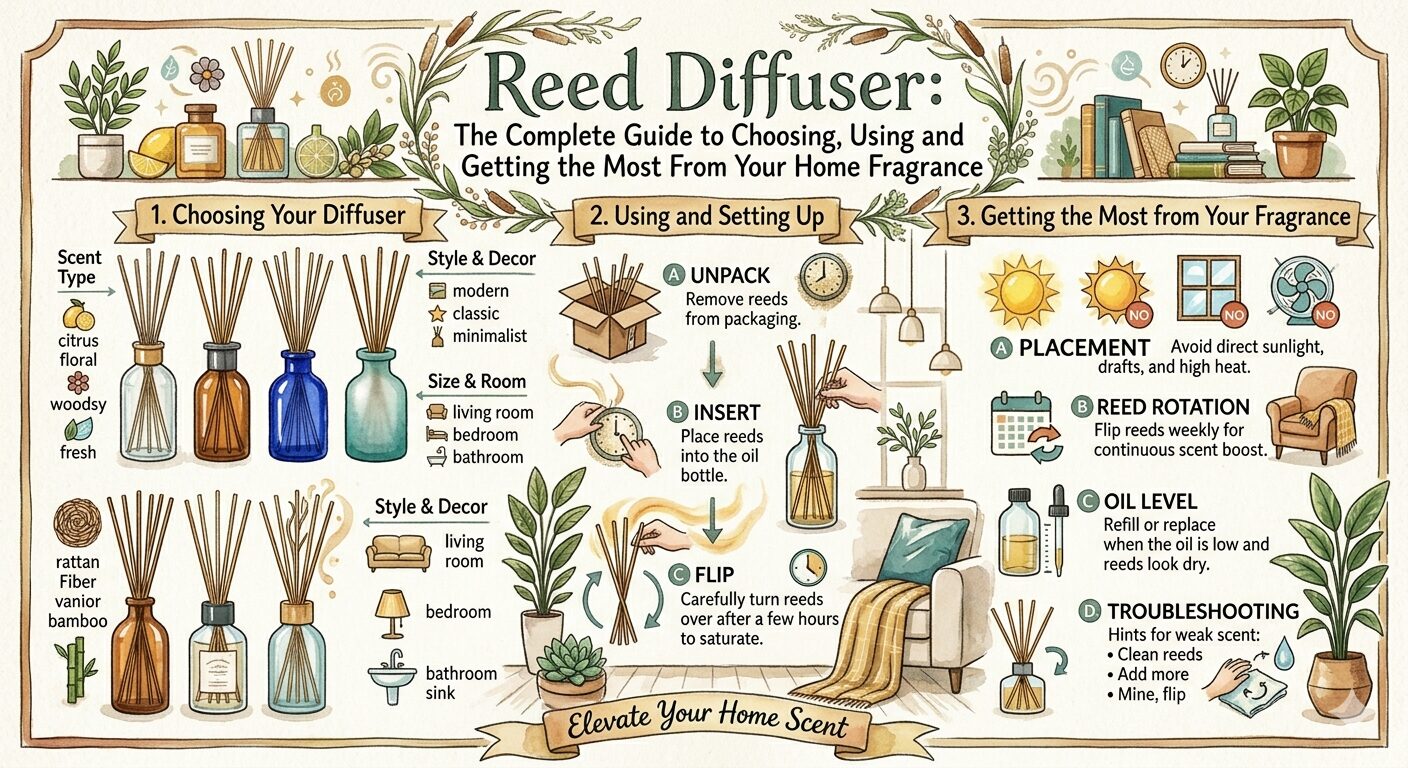
How to Use a Reed Diffuser Correctly
Setting up and maintaining a reed diffuser correctly makes a measurable difference to both the scent quality and the lifespan of the product. Follow these steps for the best results.
How Long Does a Reed Diffuser Last?
The lifespan of a reed diffuser depends on several factors working together: bottle size, fragrance oil concentration, number of reeds in use, room conditions, and how often you flip the reeds. As a general guide, a 100ml reed diffuser used conservatively lasts approximately 8 to 12 weeks. A 200ml bottle can last 12 to 20 weeks under similar conditions.
High room temperatures and strong ventilation both accelerate evaporation and shorten the life of your diffuser. A reed diffuser placed near an air conditioning vent or in a sun-facing window will exhaust its oil two to three times faster than one positioned in a cool, shaded corner.
To extend the life of your reed diffuser: use fewer reeds, flip less frequently, keep the bottle away from heat and sunlight, and cap the vessel overnight or when a room is unoccupied for extended periods. Purchasing reed diffuser refills separately is far more economical than replacing the entire set.
Best Reed Diffuser Scents for Every Room
Matching your fragrance oil choice to the function of a room is one of the simplest ways to get more out of your home reed diffuser. Different scent profiles work with the psychology and atmosphere of different spaces.
| Room | Recommended scent profile | Why it works |
|---|---|---|
| Bedroom | Lavender, sandalwood, vanilla | Calming profiles that support relaxation and sleep without stimulating the nervous system |
| Living room | White tea, citrus, amber | Welcoming and broad-appeal scents that work for guests and everyday life |
| Bathroom | Clean linen, eucalyptus, mint | Fresh, clean profiles that reinforce hygiene and refresh a small enclosed space |
| Home office | Bergamot, cedar, green notes | Studies link citrus and woody notes to improved focus, alertness, and mental clarity |
| Hallway / entrance | Rose, oud, fig, blackcurrant | Statement scents that make an immediate first impression and carry well in transitional spaces |
| Large room | Musk, oud, dense florals | High-throw fragrance profiles that fill volume without fading at the edges of the space |
Reed Diffuser vs Electric Diffuser: Key Differences
Both reed diffusers and electric aroma diffusers serve the same fundamental purpose, but they operate very differently and suit different use cases. Understanding the distinction helps you choose the right tool for each space in your home.
- No electricity required
- Continuous ambient fragrance
- Minimal maintenance needed
- Elegant, decorative presence
- Lasts weeks to months
- Fixed intensity per setup
- Adjustable output and timing
- Instant on-demand intensity
- Change fragrance any time
- Better for aromatherapy sessions
- Uses water or neat oil
- Requires power source
The most effective approach for most homes is to use both in combination: a reed diffuser for continuous background fragrance and an electric diffuser for intentional, higher-intensity aromatherapy moments. They complement each other rather than compete.
How to Make Your Reed Diffuser Last Longer
A few deliberate choices significantly extend the life of any reed diffuser without sacrificing performance.