INTRODUCTION
There’s a particular smell I associate with my aunt’s house. Warm, slightly woody, faintly floral—she always had a small terracotta diffuser on her kitchen windowsill. I didn’t know what was in it for years. Turns out it was a simple blend of lavender and cedarwood. Nothing complicated. She’d been using the same aroma oil for about fifteen years.
I mention this not because it’s fascinating, but because it captures something that often gets lost in how these products are marketed. Aroma oil, at its best, is quietly useful. It doesn’t need to be a lifestyle or a wellness identity. It can just be a thing that makes your home smell better and, sometimes, makes you feel a bit calmer.
But getting there—choosing the right oil, understanding what it can and can’t do, knowing how to use it without causing yourself a rash or a headache—takes a little more than reading the back of a bottle. So here’s what I wish someone had told me at the beginning.
FIRST, LET’S SORT OUT THE TERMINOLOGY—BECAUSE IT’S GENUINELY CONFUSING
If you’ve spent more than ten minutes looking at aroma oils online, you’ve probably run into three or four different terms being used as if they mean the same thing. They don’t, and it matters.
Essential Oils
Pure plant extracts. That’s really what it comes down to. Steam is pushed through plant material — flowers, bark, roots, resin, rind — and what comes out on the other side is the volatile aromatic compounds from that plant, suspended in a concentrated liquid. Nothing added. The lavender in a good lavender essential oil is just lavender.
This concentration is the reason they’re so potent. A single kilogram of rose Petals produce maybe one or two grams of rose essential oil. That’s why some oils are expensive and others are suspiciously cheap—if a rose essential oil costs the same as a bottle of lavender, someone is cutting corners somewhere.
Fragrance Oils
These are synthetic, or partly synthetic, scent compounds made in a laboratory. The “ocean breeze” or “fresh cotton” oil you see in candle-making supplies? Almost certainly a fragrance oil. No ocean was involved in its production.
That’s not a reason to dismiss them outright—they smell consistent, they’re affordable, and for things like candles or reed diffusers purely used for home fragrance, they do the job well. But they are not essential oils, and any therapeutic or wellness claim attached to a synthetic fragrance oil should be treated with significant skepticism.
So What Exactly Is “Aroma Oil“?
Honestly? It depends on who’s using the term. In practice, “aroma oil” most often refers to either a ready-diluted essential oil blend (mixed into a carrier oil and sold ready to apply to skin) or sometimes a natural fragrance blend used in diffusers. Some brands use it interchangeably with essential oil. Others use it to describe blends that include both natural and synthetic components.
The only way to really know what you’re buying is to read the ingredient list. Look for the Latin botanical name of the plant—Lavandula angustifolia—for lavender, and Melaleuca alternifolia for tea tree. If all you see is “parfum” or “Fragrance”—that”‘s a synthetic product, whatever the label says.
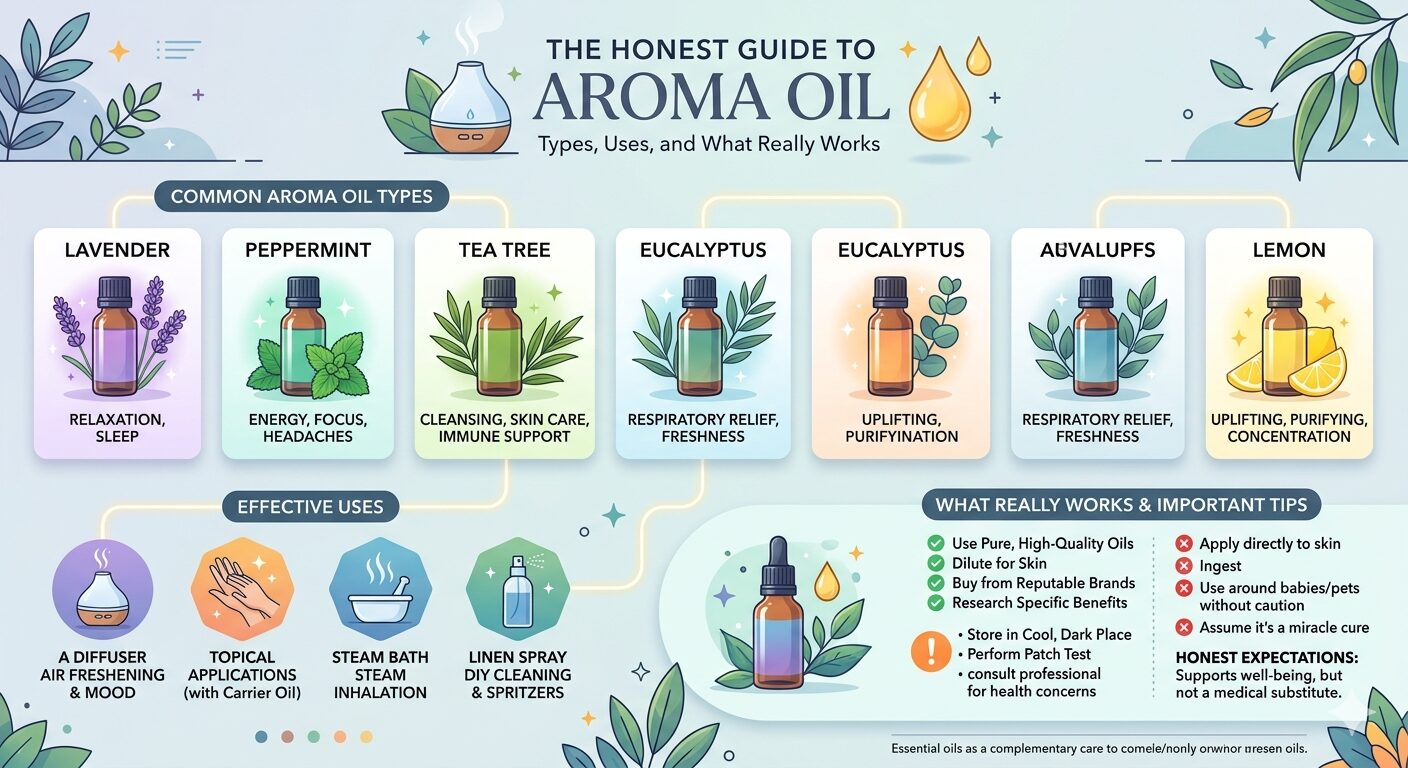
THE OILS WORTH KNOWING—AND WHAT THEY’RE ACTUALLY GOOD FOR
I’m going to be honest here: a lot of what gets written about individual aroma Oils are either vague (“promotes wellbeing”) or overclaiming (“boosts immunity,” “fights cancer”). What follows is a more grounded look at the oils most people actually use and what we reasonably know about them.
Lavender — The One That Actually Has Evidence Behind It
Lavender is the most studied essential oil in the world, and for once, the Popularity is somewhat deserved. There’s a reasonable body of research—published in journals like Phytomedicine and the Journal of Alternative and Complementary Medicine—showing measurable effects on anxiety and sleep quality in human subjects. Not every study is iron-clad, but the signal is there in a way it simply isn’t for most other oils.
For daily use: a few drops in a diffuser before bed is as simple as it gets. Diluted into a carrier oil and rubbed into the wrists or temples, it’s a pleasant ritual even if you’re agnostic about the pharmacology. It’s also one of the gentler oils for people who are new to all of this.
Peppermint — Underrated for Focus, Overrated for Everything Else
Peppermint has a sharp, cooling quality that wakes you up in a way that’s genuinely useful. A drop on a tissue held near the nose during a long afternoon meeting is a real thing that real people use and it works—though whether that’s pharmacological or just the shock of a strong smell breaking your mental fog is an open question.
There’s also some decent research on diluted peppermint oil applied to the forehead for tension headaches—a couple of small trials found effects comparable to paracetamol, which is more than most oils can claim. I’d take that with some caution, but it’s interesting.
What peppermint is not: a digestive cure-all, a weight loss aid, or a treatment for anything complicated. Claims in that territory tend to be either misapplied from research on oral peppermint capsules or simply invented.
Eucalyptus — Effective, But Worth Handling Carefully
That sharp, medicinal smell has made eucalyptus aroma oil a staple in steam inhalation for colds and congestion. There’s legitimate antimicrobial activity in the compound 1,8-cineole, and studies have explored its potential in respiratory support contexts. For a steam inhalation when you’re bunged up in February, it’s a perfectly reasonable thing to use.
The caution: eucalyptus is one of the oils that can cause real problems around young children, particularly those under ten. It shouldn’t be diffused heavily in rooms where very young children sleep, and it absolutely should not go anywhere near a child’s face. The same goes for cats and many other pets — their metabolic systems simply can’t process it.
Bergamot — The One for Mood, Without the Fuss
Bergamot is the citrus you’ve been drinking for years without realizing—it’s What gives Earl Grey tea its distinctive smell? As an aroma oil, it has a reputation for lifting mood and reducing anxiety, and there’s some research to back this up, including a 2015 study involving healthcare workers that found meaningful reductions in anxiety after bergamot aromatherapy sessions.
The one practical note: bergamot is phototoxic. If you apply it to your skin (diluted, obviously) and then go out in the sun, you can end up with uneven patches of darkened skin or a burn. Most reputable suppliers now offer bergapten-free bergamot, which removes the problematic compound. Worth checking before you buy.
Frankincense — Slower, Quieter, Actually Quite Good
Frankincense is having a moment in wellness circles and the enthusiasm isn’t entirely misplaced. The resinous, slightly balsamic scent has a genuinely grounding quality — it’s been used in religious and meditative contexts across cultures for a long time, which tells you something about how humans respond to It. Whether that’s cultural conditioning or something more physiological probably doesn’t matter much when you’re trying to wind down after a difficult day.
It blends particularly well with cedarwood and lavender for an evening diffuser combination that doesn’t smell like a health food shop, which is harder to achieve than it sounds.
HOW TO ACTUALLY USE AROMA OIL WITHOUT MAKING COMMON MISTAKES
Diffusing — The Easiest Starting Point
An ultrasonic diffuser breaks water and oil into a fine mist using vibrations. It’s the gentlest method, it doesn’t degrade the oil with heat, and most models are straightforward to clean. Three to five drops per 100 ml of water is a standard starting point — though with stronger oils like eucalyptus or peppermint, two drops is plenty.
The thing most guides don’t mention: you don’t need to diffuse continuously. Running a diffuser for 30–45 minutes and then turning it off is a more sensible approach than filling the room with scent all day. Your nose acclimatises quickly. and constant exposure means you stop benefiting from the scent while continuing to breathe it in.
Topical Use — Dilution Is Not Optional
Undiluted essential oil on skin is a bad idea. This isn’t a mild precaution—itcan cause chemical burns, sensitisation (which builds over time and becomes permanent), and in some cases, serious allergic reactions. The fact that it’s Nature is entirely irrelevant to its capacity to irritate.
The standard adult dilution is 2%. In practice, that’s about 12 drops of essential oil per 30ml of carrier oil. Jojoba, sweet almond, and fractionated coconut are the workhorses here—they absorb reasonably well, they’re relatively shelf-stable, and they don’t have strong competing scents.
For children or sensitive skin, halve it. And do a patch test first—inner forearm, 24 hours before applying anywhere broader.
Steam Inhalation
A bowl of hot water, two drops of eucalyptus or peppermint, and a towel over your head. Not boiling — hot enough to produce steam but not so hot that you risk a burn. Breathe slowly for a few minutes. It’s old-fashioned, and it works about as well as anything else for simple congestion. Keep your eyes closed; essential oil Vapor and eyes are not a good combination.
What to Avoid
Taking oils internally without professional guidance is probably the most common dangerous advice circulating online. “Food grade” does not mean “safe to consume.” Ingesting essential oils can cause liver toxicity, chemical burns to the esophagus, and serious illness, particularly in children. No reputable Aromatherapy body recommends internal use without clinical supervision.
Keep oils away from eyes, ears, and mucous membranes. Store them in dark glass away from heat. Check compatibility if you have pets—the Tisserand Institute (tisserandinstitute.org) maintains freely accessible safety guidelines for animals that are worth consulting.
WHAT THE SCIENCE ACTUALLY SAYS — AND WHERE IT STAYS QUIET
Aromatherapy research is real, but it’s uneven. The strongest evidence tends to be in mood and anxiety — particularly for lavender — and in some topical antimicrobial applications. The weakest evidence is in the area of treating specific diseases, which is where a lot of marketing unfortunately tends to venture.
The physiological basis for why aroma oil affects mood is reasonably well-established. understood: the olfactory system connects directly to the limbic system, which handles emotional processing and memory. That’s why a smell can trigger a memory more vividly than a photograph. It’s not mystical—it’s just how olfaction works anatomically.
What’s less clear is the precise therapeutic ceiling of these effects: how strong they are, how reproducible they are across individuals, and whether they are sufficient to treat anything serious. The honest answer is that the research is promising but incomplete, and anyone claiming certainty in either direction — miracle cure or useless placebo — is outrunning the evidence.
A good place to look for grounded information: the National Association for Holistic Aromatherapy at naha.org, and PubMed (pubmed.ncbi.nlm.nih.gov) if you want to go directly to research papers. The Tisserand Institute at tisserandinstitute.org publishes safety-focused material that is both well-researched and accessible.
BUILDING A FIRST COLLECTION — KEEP IT SMALL
Five oils is enough to start. More than that and you end up with half-empty bottles you don’t know what to do with. Lavender. Peppermint. Eucalyptus. Sweet orange or bergamot. Frankincense.
That covers sleep support, focus, respiratory use, mood, and grounding—and From those five you can build a reasonable range of blends. Once you’ve used them long enough to know what you actually reach for, you can start expanding.
On quality: buy from suppliers who display the Latin botanical name, country of plant origin, and ideally GC/MS test results (gas chromatography analysis that confirms purity). These aren’t exotic requirements—any serious supplier provides them. If a brand doesn’t, that’s informative.
Price is a rough proxy for quality, but it’s not infallible. What you’re looking for is transparency, not luxury branding.
FREQUENTLY ASKED QUESTIONS
Is there a difference between aroma oil and essential oil?
Yes, though the terms get used loosely. “Essential oil” specifically means a pure, undiluted plant extract. Aroma oil is a broader category that can include essential oils, carrier-oil blends, and in some cases, synthetic or semi-synthetic fragrance compounds. Reading the ingredient label is the only reliable way to know what a specific product actually contains.
Can I use aroma oil if I have asthma?
Some people with asthma find certain oils—particularly eucalyptus, rosemary, and strong menthol blends can trigger symptoms. Others use lavender without issue. The sensible approach is to start with mild exposure, use good ventilation, and speak to your GP or a qualified aromatherapist before making it a regular practice. Don’t take advice from a bottle.
How long do aroma oils stay good?
Most essential oils last one to three years when stored correctly—dark glass, cool and away from sunlight. Citrus oils tend to oxidize faster, often within a year. Resins like frankincense and sandalwood last longer. When an oil smells flat, rancid, or noticeably different from when you opened it, trust that instinct — Oxidized oils can cause skin sensitization.
Is it safe to use during pregnancy?
This is one area where I’d be cautious about any generalised advice, including this article. Several oils—clary sage, rosemary, juniper, among others—are traditionally avoided in pregnancy, particularly the first trimester. Some Midwives recommend avoiding strong aromatherapy altogether in early pregnancy. Speak to your midwife first. It’s not worth guessing.
My cat keeps walking into the room when I diffuse. Is that okay?
Cats cannot metabolize many of the compounds in essential oils the way humans can. Tea tree, eucalyptus, citrus oils, and several others are genuinely toxic to cats in concentrated form. If your cat voluntarily moves away from a diffused scent, Let them. Diffuse in a room the cat can leave freely, keep concentrations low, and avoid oils known to be feline-toxic. The Tisserand Institute’s pet safety Resources are a better guide than most things you’ll find on this.
Do I need to spend a lot on a diffuser?
No. A reliable ultrasonic diffuser in the £25–£45 range will serve most people well. What matters is consistent mist output, easy cleaning, and adequate tank size for your space. Avoid heat-based diffusers—they alter the oil’s chemical structure. composition, which defeats part of the purpose. Beyond that, the expensive models are mostly paying for aesthetics.
CONCLUSION
Aroma oil is not complicated, but it does reward a bit of knowledge and a bit of patience. The people who get the most out of it are usually those who start with two or three oils, use them regularly, and pay attention to what they notice — rather than those who buy twelve bottles in the first week and try to fix everything at once.
The science supports measured, realistic expectations. Some oils genuinely help with mood, sleep, and minor physical discomfort. None of them are a substitute for medical care, and none of them should be treated as though they are.
Start small. Buy from transparent suppliers. Dilute properly. Pay attention to how you feel. That’s really most of it.